Nothing is simple when it comes to the compilation of ancient writings, known as the Bible. For thousands of years, believers have debated its meaning and divided themselves into thousands of denominations.
It’s time to get honest about the subject of human sacrifice. While firm adherents take the stance that the god of the old testament was always firmly against human sacrifice, the truth is that this is not a clear message being conveyed.
Among the experts, the scholars, there is no consensus on exactly where Yahweh wanted.
Let’s actually put the passages beside one another and check out what it really says about this subject.
1. Firstborn sons are commanded to be “given” to Yahweh
Exodus 22:29–30 says:
“The firstborn of your sons you shall give me. You shall do the same with your cattle and your flocks…”
That wording of the first law surrounding the subject is striking.
The firstborn son is mentioned alongside the firstborn animals being given to Yahweh. We know full well what thy were doing with cattle and the flocks – sacrificing them.
In this passage, there is no instruction to redeem the son or substitute money for him. That instruction appears elsewhere, later.
It certainly seems like the verse originally commanded human sacrifice.
Some scholars have proposed that the biblical legislation preserves an earlier tradition in which the firstborn belonged to the deity, was sacrificed to the deity, and that redemption, instead of being sacrificed, may represent a later modification of that older concept.
And that brings us to the next passage.
2. The firstborn son must be redeemed
In Exodus 13:12–15, the firstborn still belongs to Yahweh — but the human firstborn is to be redeemed, or paid for.
The instruction is:
“Every firstborn of your sons you shall redeem.”
Exodus 34:19–20 gives essentially the same arrangement: the firstborn belongs to Yahweh, but the firstborn son must be redeemed through a payment of five shekels.
There is even another interesting clue on evolution of sacrifice.
In Numbers 3 and 8, the Levites are taken in place of Israel’s firstborn. The text presents the Levites as belonging to Yahweh in place of the firstborn.
That raises another possibility: perhaps the firstborn originally had a special sacred status that was later
3. Then Yahweh says some laws were “not good” and defiled them the people
This is where the “good book” becomes particularly difficult.
Ezekiel 20:25–26 says:
So I gave them other statutes that were not good and laws through which they could not live; I defiled them through their gifts—the sacrifice of every firstborn—that I might fill them with horror so they would know that I am the Lord.’
Read that again if you can let that sink in.
The speaker is Yahweh.
The text says that he gave them statutes that were not good, to fill them with horror and it connects those statutes directly with the sacrifice of the firstborn.
There are different scholarly interpretations of Ezekiel 20, so it would be too simplistic to say that this passage settles the question of whether Yahweh literally commanded child sacrifice.
But the passage undeniably creates a serious problem.
4. Then Yahweh says: “I did not command it”
Now compare Ezekiel with Jeremiah.
Jeremiah 7:31 describes people setting up idols and burning their sons and daughters at Topheth and then proclaims the practice was not:
“something I did not command, nor did it enter my mind.”
Here we have a biblical text presenting Yahweh as saying that he never commanded child sacrifice. At the same time, he does not seem to outright condemn the practice. It seems rather blase to me, somewhat like “I never commanded you to bake me a cake, nor did it enter my mind.”
So now we have:
Exodus: Give me your firstborn son.
Exodus: The firstborn son belongs to Yahweh but must be redeemed for five shekels and serve in the temple
Numbers: The Levites take the place of the first born serving Yahweh
Ezekiel: Yahweh admits giving statutes that were “not good,” including the sacrifice of every firstborn.
Jeremiah: Yahweh says child sacrifice was something he did not command.
How do we reconcile all of that?
5. Was the problem the sacrifice — or who received it?
There is another interesting detail.
When the Bible condemns child sacrifice, it specifically connects the sacrifice with idols or other gods.
For example, Ezekiel 16:20–21 says:
“you took your sons and daughters whom you bore to me and sacrificed them as food to the idols.”
and:
Take note of the language.
“You slaughtered my children and sacrificed them to the idols.”
The children are described as “my children” — yet they are being sacrificed to idols. “How dare you sacrifice my children to other gods or idols“?
Likewise, Ezekiel 20:30–31 connects the sacrifice of children with their idols.
“The Sovereign Lord says: Will you defile yourselves the way your ancestors did and lust after their vile images? When you offer your gifts—the sacrifice of your children in the fire—you continue to defile yourselves with all your idols to this day. Am I to let you inquire of me, you Israelites?”
So the biblical picture is absolutely not as simple as:
“Yahweh absolutely prohibited human sacrifice from the beginning.”
The texts are much more complicated than that.
6. The uncomfortable possibility: religious evolution
One possible scholarly reconstruction looks something like this:
Firstborn belongs to the deity → firstborn is given/dedicated → firstborn is redeemed instead of sacrificed → Levites are redeemed instead of the first born.
If that reconstruction is correct, the redemption laws could represent a development away from an older sacrificial practice.
And it would explain why the language of belonging to Yahweh is so prominent even after the actual sacrifice has been replaced by redemption.
7. And then there is Abraham and Isaac
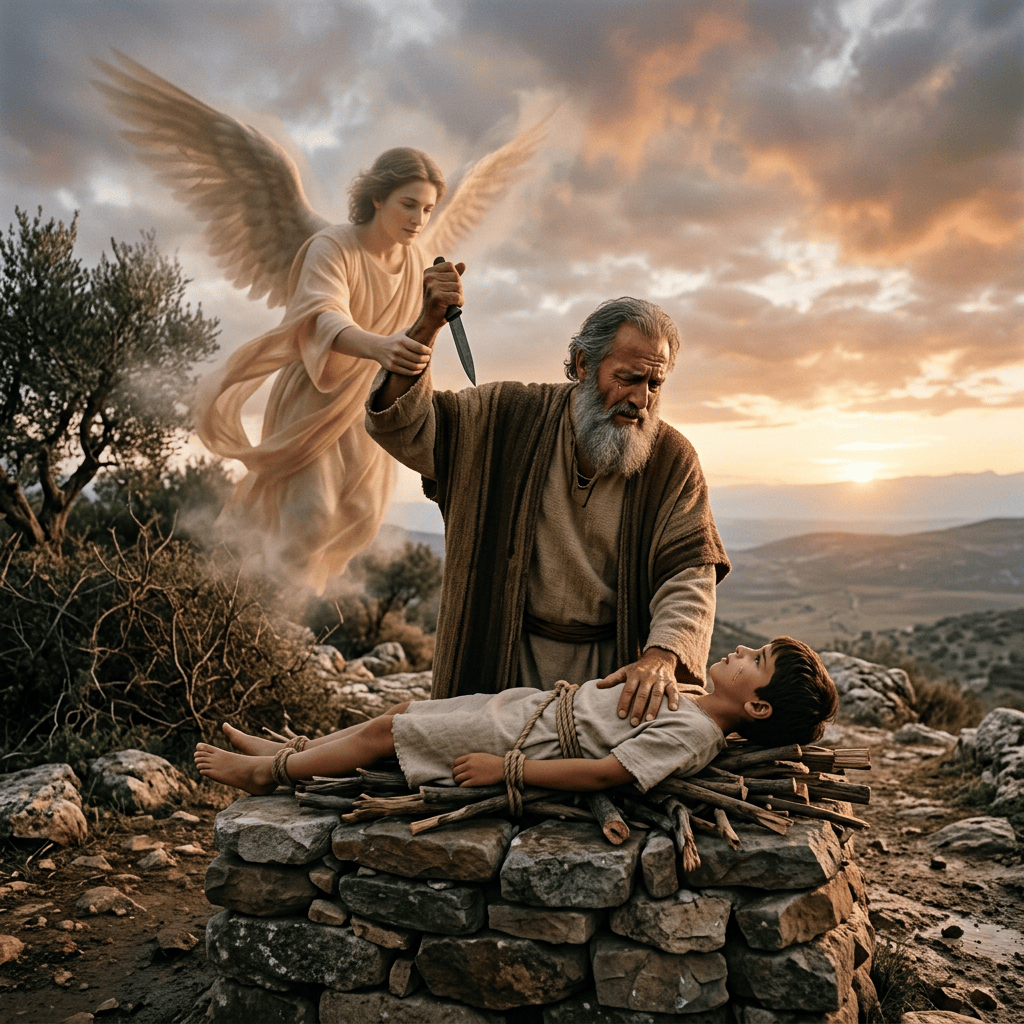
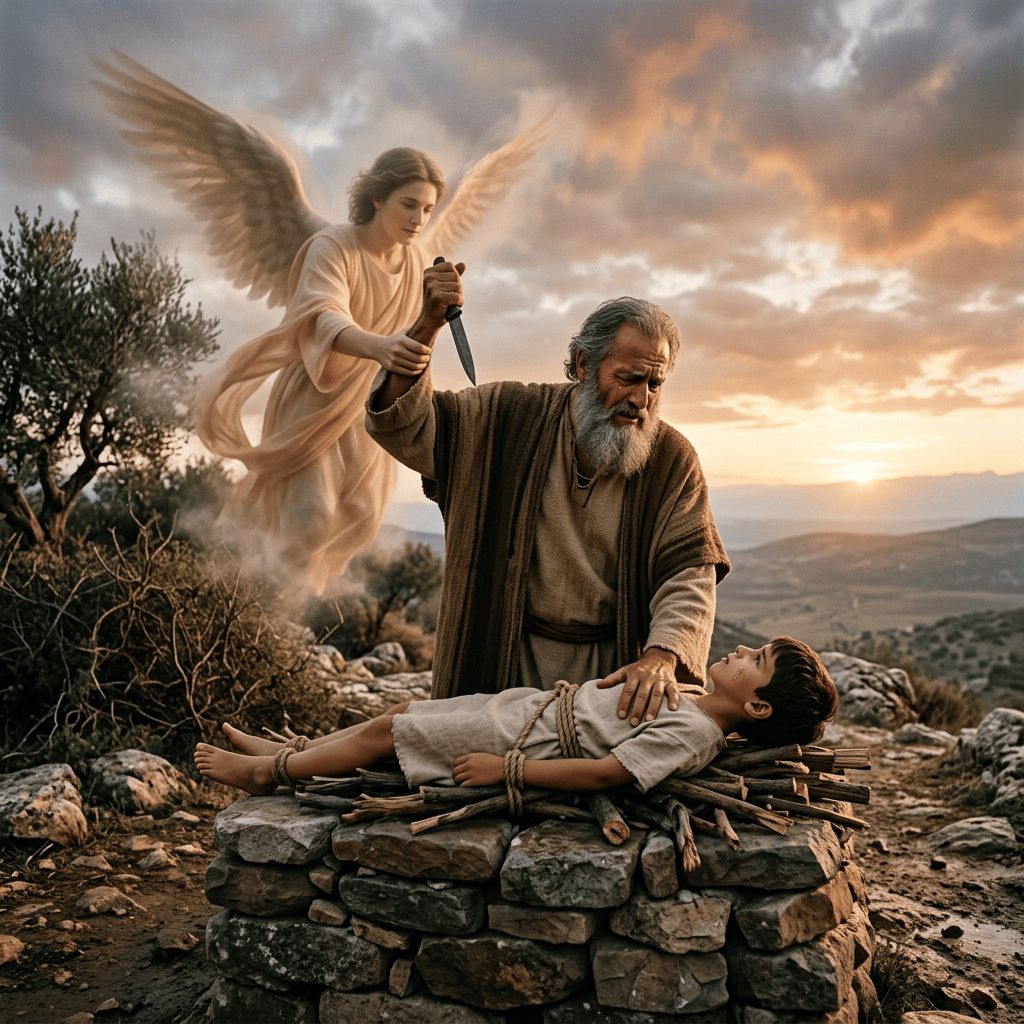
The story of Abraham and Isaac in Genesis 22 becomes even more interesting when viewed against this background.
God tells Abraham to offer his son Isaac as a burnt offering.
Abraham prepares to do exactly that.
At the last moment, God stops him and provides a ram instead.
The traditional Christian interpretation is that this demonstrates that God does not ultimately want human sacrifice. That is certainly one way to read the story. But notice something important: The story does not begin with:
“God would never ask a father to sacrifice his son.” It begins with God asking Abraham to offer his son.
Interestingly, Isaac was not Abraham’s first born and we can tell from the passages that he is not a baby. We also know that Isaac is Abraham’s favorite child. We also do not now if Abraham actually had a first born who was sacrificed or perhaps lived.
If this story is merely about Yahweh wanting to test Abraham’s loyalty, it brings to mind the question – if he is an all knowing god, why didn’t he know Abraham’s loyalty until the moment the knife was raised to kill his son Isaac?
8. The sacrifice of Jephthah’s Daughter
This is a disturbing story found in Judges 11.
Jephthah makes a vow to Yahweh: if Yahweh gives him victory in battle, Jephthah will offer as a burnt offering whatever comes out of the door of his house to meet him when he returns. Unfortunately for Jephthah, his beloved daughter is the first to come through the door.
After Yahweh gives Jephthah victory over the Ammonites, his daughter comes out to meet him. Jephthah tells her about his vow, and the story ends by saying that he “did with her according to his vow.”
The traditional reading is that Jephthah literally sacrificed his daughter as a burnt offering.
What is remarkable about the story is what it doesn’t say. There is no statement that Yahweh condemns Jephthah for making the vow. There is no punishment from Yahweh for carrying it out. There is no divine intervention to stop the sacrifice, as there is in the story of Isaac. There is not even a statement that Yahweh was displeased with what Jephthah did.
Some Christians defend the story by suggesting that its moral is simply “be careful about the vows you make.” But that interpretation is an inference; the narrator But that interpretation is an inference; the narrator never actually says that this is the lesson. In fact, the narrator’s striking silence leaves us with a much more disturbing question: if Jephthah really sacrificed his daughter to Yahweh, why does Yahweh never object?
The narrator does not pause to explain that Jephthah misunderstood Yahweh’s wishes. He does not tell us that Yahweh rejected the offering. He does not record a prophet confronting Jephthah, nor does he describe any divine punishment for the act itself. Instead, the story simply moves on.
That silence does not, by itself, prove that the biblical authors approved of human sacrifice. Ancient narratives often leave moral judgments unstated, and the book of Judges as a whole frequently depicts terrible events without explicitly stopping to condemn every one of them. Nevertheless, if we approach the Bible as a collection of stories deliberately inspired by God to teach humanity moral and theological truths, the silence is difficult to ignore.
Why include a story in which a man makes a vow to Yahweh, wins a military victory through Yahweh’s assistance, and then apparently fulfills that vow by giving his daughter to Yahweh—without recording any divine condemnation of the sacrifice?
That is especially striking when compared with Genesis 22. There, Abraham is prepared to sacrifice his son Isaac, but God intervenes and stops him. In Judges 11, no such intervention occurs. The contrast raises an uncomfortable question: why does God stop Abraham from sacrificing Isaac, but apparently allow Jephthah to carry out his vow?
The traditional explanation that the story is simply a warning about making rash vows may be reasonable as an interpretation, but it is not something the narrator explicitly tells us. The text itself leaves the reader with the disturbing impression that Jephthah made a vow to Yahweh, Yahweh granted him victory, and Jephthah subsequently fulfilled the vow at the terrible cost of his daughter’s life with no reaction from Yahweh.
9. So what are we actually left with?
The Bible does not give us one simple, consistent statement about human sacrifice. It’s clear that the bible is actually unclear.
Instead, we find several different strands:
Yahweh asks Abraham for the sacrifice of a son who is not a firstborn, then recants
A firstborn son is to be “given” to Yahweh.
The firstborn son belongs to Yahweh but must be redeemed with five shekels and must serve in the temple
Jephthah sacrifices his daughter after making a vow to Yahweh with no reaction whatsoever from the god.
Yahweh admits giving Israel statutes that were “not good,” including the sacrifice of every firstborn. He admits he defiled them and filled them with horror.
Jeremiah says Yahweh never commanded child sacrifice.
Sacrifice of children is condemned when it is done to other gods or to idols.
Passages condemn child sacrifice – when it is offered to idols or other gods.
The Bible certainly presents far from a completely straightforward and consistent prohibition from beginning to end.
The texts themselves preserve competing ideas.
And perhaps that is the more interesting question:
It seems that we are looking at a collection of ancient traditions reflecting different stages of Israelite religion?
The Bible contains mixed messages about human sacrifice
Some passages appear to prohibit it as a detestable practice that Yahweh never commanded, while other passages have been interpreted by scholars as preserving traditions in which the firstborn was to be given to Yahweh. Other stories, such as Jephthah’s vow, raise further questions because the narrative does not explicitly condemn the resulting sacrifice. Rather than presenting a single, consistent position, the biblical texts appear to preserve different traditions and changing attitudes toward sacrifice.
Whether he god wanted a human or an animal sacrifice, it’s clear that at some points in history, he wanted the blood and death of innocents in order to forgive or give blessing to his ‘chosen’ people.
When a god has access to all available resources in all of the universe, as well as intelligence and imagination, we might ask what kind of god needs the death and blood of innocents on order to forgive or bless?
“See it for what it is, not for what you want it to be.”
If you’re interested in some scholarly takes, here is some further reading.
Child Sacrifice in Seventh-Century Judah and the Origins of Passover by Lukasz Niesiolowski-Spano
‘I gave them laws that were not good’ (Ezk 20:25): A biblical model of complex subjectivity and the prospects of multi-ethnic contextual reading by Dexter E. Callender


Leave a comment