As news headlines once again proclaim a possible Noah’s Ark discovery, I thought it appropriate to inform readers of the many failed claims over a long period of history.
For centuries, explorers, religious enthusiasts, military personnel, archaeologists and amateur investigators have searched The Mount Ararat area in Turkey for the ark and many have claimed to have found it, photographed it or recovered pieces of the original vessel.
Despite the extraordinary number of claims, no discovery of Noah’s Ark has ever been independently authenticated by the archaeological community.
The following chronology documents the history of these claims, including alleged sightings, expeditions, recovered wood, satellite photographs, hoaxes and scientific investigations.
The entries below document what was claimed and what happened afterward.
1. Ancient and Medieval Accounts (275 BCE–1670)
Reports of the Ark’s remains predate modern archaeology by centuries. Ancient writers described people claiming to have seen remnants of the vessel in the mountains of Armenia and surrounding regions.
| Date | Person or source | Report |
|---|---|---|
| c. 275 BCE | Berossus | Reported that remnants of the Ark could be found in the mountains of the Gordyaeans. |
| c. 93 CE | Flavius Josephus | Wrote that remains of the Ark were still shown in Armenia. |
| c. 375 CE | Epiphanius | Reported Ark remains in the Cardyaei region. |
| c. 400 CE | Armenian tradition | Accounts of an Ark plank preserved at Etchmiadzin. |
| c. 560 CE | Isidore of Seville | Reported that Ark remains could be seen on the mountain. |
| c. 620–628 CE | Emperor Heraclius | Tradition associates him with a visit to the mountain where the Ark was believed to rest. |
| 632 CE | Islamic tradition | The Quran identifies Mount Judi as the place where the Ark came to rest. |
| 13th century | Marco Polo | Reported traditions of Noah’s Ark on a mountain in Armenia. |
| 1307 | Hayton of Corycus | Described an object associated with the Ark on Mount Ararat. |
| 1647 | Adam Olearius | Reported accounts of petrified Ark remains. |
| 1670 | Jan Janszoon Struys | Reportedly described wood associated with the Ark. |
For a broader historical chronology, see Noah’s Ark Tracker – historical discovery claims.
2. Early Expeditions and Alleged Sightings (1829–1953)
As exploration of Mount Ararat became more accessible, claims of sightings and discoveries increased.
| Date | Person or expedition | Discovery or claim |
|---|---|---|
| 1829 | Friedrich Parrot | First recorded successful ascent of Mount Ararat. No Ark discovered. |
| 1832–1850 | Turkish, Russian and British expeditions | Various searches for the Ark; no authenticated remains recovered. |
| 1856 | Haji Yearam story | A later-circulated account alleged that British scientists discovered the Ark during a secret expedition. |
| 1876 | James Bryce | Reported finding a piece of worked timber high on Mount Ararat. Its connection to the Ark was never established. |
| 1883 | Turkish commission story | Alleged discovery of a large wooden structure protruding from a glacier. The famous newspaper version was an April Fools’ hoax. |
| 1887 | Prince John Joseph Nouri | Claimed to have discovered the Ark after repeated expeditions. No verifiable evidence followed. |
| 1908 | Georgie Hagopian | Later claimed to have visited the Ark as a child with his uncle. |
| 1910 | Georgie Hagopian | Allegedly made a second visit. |
| 1916 | Vladimir Roskovitsky | Story of a Russian aviator supposedly spotting the Ark from an aircraft. |
| 1917 | Russian military expedition story | Alleged expedition to document and photograph the Ark. No independently verifiable records emerged. |
| 1940 | New Eden magazine | Published the Roskovitsky story. |
| 1943 | American military personnel | Reports of alleged sightings and photographs. |
| 1945 | Turkish soldier | Claimed to have photographed the Ark from an aircraft. |
| 1948 | Kurdish farmer Reshit | Reportedly described a petrified ship-like structure on Ararat. |
| 1949 | Aaron J. Smith | Organized an expedition that failed to locate the Ark. |
| 1949 | Aerial photography | A ship-shaped formation was reported on Mount Ararat. |
| 1952 | Jean de Riquer | French expedition failed to find the Ark. |
| 1953 | George Green | Claimed to have photographed the Ark from a helicopter. The photographs were never made available for independent verification. |
Many of these stories were circulated years or decades after the alleged events. Their dates should not be confused with the dates on which the accounts were first documented.
A more extensive collection of these historical reports can be found in the sourced chronology of Noah’s Ark searches.
3. Navarra, Durupınar and the Modern Searches (1955–1988)
The middle of the twentieth century produced some of the most widely publicized claims.
One of the most important developments was the discovery of a ship-shaped geological formation near Mount Ararat, subsequently known as the Durupınar formation.
| Date | Person or expedition | Discovery or claim |
|---|---|---|
| 1955 | Fernand Navarra | Claimed to recover wooden timber from beneath glacier ice on Mount Ararat. |
| 1959 | Captain İlhan Durupınar | Identified a ship-shaped formation in aerial photographs. |
| 1960 | American-Turkish expedition | Investigated the Durupınar formation but found no archaeological remains. |
| 1969 | Fernand Navarra / SEARCH Foundation | Recovered additional pieces of wood associated with Ark claims. |
| 1970 | Georgie Hagopian | Publicly recounted his alleged childhood visits to the Ark. |
| 1973 | Haji Yearam story | An alleged deathbed account of the supposed 1856 discovery circulated. |
| 1973 | ERTS satellite imagery | Satellite imagery was promoted as potentially showing the Ark. |
| 1976 | In Search of Noah’s Ark | Documentary released, popularizing the search for the vessel. |
| 1977 | Ron Wyatt | Began promoting the Durupınar formation as Noah’s Ark. |
| 1982 | James Irwin | Led an expedition to Mount Ararat; the search was unsuccessful and Irwin was injured. |
| 1985 | Ron Wyatt and David Fasold | Conducted radar and metal-detector investigations at Durupınar. |
| 24 August 1985 | James Irwin | Climbed Mount Ararat under military escort. |
| 1987 | James Irwin’s team | Further investigation of the mountain. No authenticated discovery. |
| 1988 | David Fasold | Published The Ark of Noah, promoting the Durupınar interpretation. |
What happened to the Navarra wood?
Fernand Navarra’s alleged recovery of wood in 1955 and 1969 attracted considerable attention. As a child, I remember our family going to see the movie surrounding this discovery. I believe it my first time in a theatre.
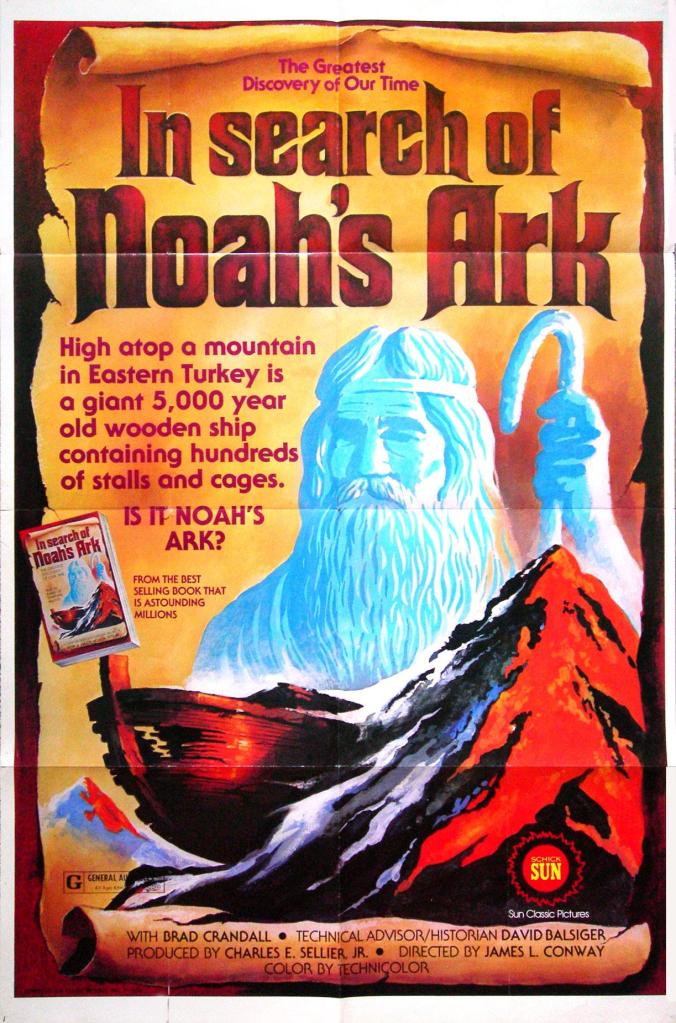
The widespread story fell flat on it’s face when radiocarbon testing produced dates substantially later than the conventional biblical chronology for Noah’s Flood.
The reported dates for the 1955 sample included approximately 720–790 CE from several laboratories. Samples from 1969 were dated to approximately 620–650 CE.
See the radiocarbon dating results discussed by TalkOrigins and the published laboratory results reproduced in Origins.
Even if the wood was genuinely recovered from the mountain, its age did not establish a connection to Noah’s Ark.
What happened to the Durupınar discovery?
The formation initially attracted considerable excitement because its outline resembles a large vessel.
However, geological investigations challenged the interpretation.
In 1996, geologist Lorence Collins and David Fasold published a scientific paper titled:
Bogus “Noah’s Ark” from Turkey Exposed as a Common Geologic Structure.
Their investigation examined supposed metal fittings, petrified wood and other features that had been promoted as evidence of a vessel.
They concluded that the supposed artifacts were natural geological materials and that the formation was not a ship.
A further examination was published by Collins in 2016:
Noah’s Ark near Doğubayazıt, Turkey?.
The existence of a ship-shaped formation is not evidence that a ship is buried there.
4. Satellite Images, Hoaxes and Further Expeditions (1990–2007)
As satellite technology improved, new claims emerged based on photographs, radar images and supposed anomalies.
| Date | Person or organization | Discovery or claim |
|---|---|---|
| 1990 | Satellite-image enthusiasts | Promoted enhanced images as evidence of a box-shaped structure on Ararat. |
| 1992 | Institute for Creation Research | Reviewed and challenged alleged Ark sightings. |
| 1992 | Andrew Snelling | Challenged the Durupınar Ark interpretation. |
| 1993 | CBS / George Jammal | Broadcast an alleged discovery story involving the Ark. |
| 30 October 1993 | George Jammal | Admitted that his CBS discovery story was a hoax. |
| 1994 | CIA imagery investigation | Imagery investigation proved inconclusive. |
| 1994 | David Fasold and Ian Plimer | Further investigation and scientific criticism of the boat interpretation. |
| 14 March 1995 | Defense Intelligence Agency | Released photographs of an anomaly on Mount Ararat. |
| 1996 | Lorence Collins and David Fasold | Published a geological explanation of the Durupınar formation. |
| 1997 | Plimer v. Roberts | Court proceedings involving Ark-related claims. |
| 2000 | Insight magazine | Published satellite anomaly claims. |
| 2004 | McGivern | Announced an expedition to investigate an alleged anomaly. |
| 23 November 2004 | Hong Kong expedition team | Claimed to have found pieces of the Ark. |
| 2006 | CNN | Reported on satellite imagery investigations. |
| 2006 | BASE Institute | Announced an alleged Ark candidate in Iran. |
| 2007 | Geological study | Examined a limestone formation associated with Ark claims. |
One of the most revealing incidents was the 1993 CBS story.
George Jammal participated in a televised account of an alleged discovery of the Ark. He subsequently admitted that the story was fabricated.
This is a relevant example of how a discovery claim can receive widespread publicity despite having absolutely no authentic archaeological evidence behind it.
5. The Noah’s Ark Ministries International Discovery (2010–2021)
One of the biggest modern announcements came in April 2010.
A Hong Kong-based evangelical organization, Noah’s Ark Ministries International (NAMI), announced that its team had discovered wooden chambers high on Mount Ararat. In the press conference, Its representative, Yeung Wing-cheung, made this extraordinary statement:
“It’s not 100 percent that it is Noah’s Ark, but we think it is 99.9 percent that this is it.”
The announcement generated international publicity.
The discovery was immediately challenged and found to be a false claim, with Dr. J. Randall Price, an American biblical archaeologist, author, evangelical Christian scholar and specialist in biblical history and Judaic studies was instrumental in calling the discover false.
Price subsequently reported that:
- The wood appeared to be modern.
- A local individual allegedly described helping construct the wooden structure.
- The evidence suggested the site was a staged fabrication rather than an ancient archaeological discovery.
These were serious allegations, although they were not the same as a completed, independent forensic investigation. Creation.com+
| Date | Person or organization | Development |
|---|---|---|
| 25 April 2010 | Noah’s Ark Ministries International | Announced discovery of wooden chambers on Mount Ararat. |
| 28 April 2010 | Randall Price | Questioned the authenticity of the discovery. |
| 30 April 2010 | NAMI | Defended its claims. |
| October 2010 | Donald Mackenzie | A searcher was reportedly reported missing. |
| 2011 | Andrew Snelling | Questioned the wood evidence and its interpretation. |
| 2015 | Institute for Creation Research | Published further criticism of Ark discovery claims. |
| 2016 | Lorence Collins | Challenged the identification of alleged Ark wood, arguing that the material was basalt. |
| 2020 | Institute for Creation Research | Revisited the absence of authenticated Ark evidence. |
The central problem with the NAMI announcement was the absence of independently established archaeological provenance. The age of a piece of wood does not establish that it came from Noah’s Ark.
Nor does finding wood at a particular location establish its identity.
Further reading:
- Christian Science Monitor – 2010 discovery announcement
- Noah’s Ark Tracker – 2010 discovery and subsequent criticism
6. The Latest Claims and Investigations (2022–November 2026)
Despite centuries of unsuccessful searches, the Durupınar formation continues to attract attention.
New technology, including ground-penetrating radar, satellite imagery and drilling equipment, has been used to investigate the formation.
| Date | Person or organization | Development |
|---|---|---|
| December 2022 | Turkish university researchers | Began sampling the Durupınar formation. |
| October 2023 | Turkish researchers | Announced sample ages reportedly between 3,500 and 5,000 years. These dates do not establish the presence of a vessel. |
| May 2024 | Research teams | Published radar and LiDAR investigations. |
| October 2024 | Media reports | Renewed Ark discovery claims. |
| April 2025 | Media reports | Reported plans for further investigation. |
| May 2025 | Noah’s Ark Scans | Claimed evidence of a man-made structure. |
| June 2025 | Turkish geological interpretation | Supported a natural landslide explanation. |
| June–September 2026 | Durupınar field team | Conducted further radar, drilling and geological investigations. |
| 28 September 2026 | Doğruluk Payı | Published a fact-check of new claims. |
| 29 September 2026 | Skeptical Inquirer | Examined renewed discovery claims. |
| 1 October 2026 | Radar research team | Announced findings said to challenge the geological explanation. |
| 2 October 2026 | Local governor | Stated that there was no scientific certainty. |
| 15 October 2026 | Atila research team | Presented interim radar results. |
| 19 October 2026 | La Trobe University team | Reported deployment of a robot at Durupınar. |
| 21 October 2026 | Engineers’ assessment | Challenged the alleged chamber evidence. |
| 26–27 October 2026 | Noah’s Ark Scans | Announced recovery of alleged charred wood from underground. |
| 4 November 2026 | Noah’s Ark Scans | Released footage claimed to show the interior of the hull. |
| 10 November 2026 | Noah’s Ark Scans | Released photographs of the recovered wood. |
| 13 November 2026 | Andrew Snelling | Reviewed and challenged the latest claims. |
| 18 November 2026 | The Jerusalem Post | Reported that wood fragments were undergoing carbon-14 dating and species identification. |
| 21–22 November 2026 | Noah’s Ark Scans | Announced preliminary carbon-14 dates for two wood samples, claiming they were approximately 4,300 years old. |
The November 2026 wood discovery
The latest announcement deserves particular attention.
Researchers associated with Noah’s Ark Scans say they recovered what appear to be charred wood fragments approximately nine metres (30 feet) below the surface of the Durupınar formation.
The initial announcement was reported by Fox News on November 10, 2026.
On November 18, The Jerusalem Post reported that the fragments were undergoing laboratory testing, including carbon-14 dating, wood identification and testing for possible traces of bitumen or sap.
Then, on November 21–22, Andrew Jones of Noah’s Ark Scans announced that preliminary results from a US laboratory placed two samples at approximately 4,300 years old.
The announcement was reported by Fox News on November 22.
This is potentially interesting, but there are important qualifications.
As of November 23, 2026:
- The research group has announced preliminary dates for two samples.
- The full laboratory report and supporting sample documentation have not been publicly released.
- Results from other laboratories are still pending.
- The age of the wood does not establish that it belonged to a ship.
- The age of the wood does not establish that it was part of Noah’s Ark.
No independent archaeological confirmation of the Ark has been published.
A useful examination of the distinction between dating wood and identifying a vessel is available in this November 22 analysis.
A radiocarbon date tells us approximately when the material grew. It does not tell us what structure the wood came from, how it arrived at the location or whether it has any connection to a biblical event.
Even if the wood proves to be 4,300 years old, that alone would not establish the Ark hypothesis.
Conclusion: Centuries of Searching, Still No Verified Ark
The history of Noah’s Ark discoveries is a fascinating record of human belief, religious conviction, exploration and wishful thinking.
For more than 2,000 years, people have reported sightings and remains of the vessel. In the modern era, the claims have included:
- Wooden beams supposedly recovered from glaciers.
- Ship-shaped geological formations.
- Aerial photographs and satellite anomalies.
- Radar images allegedly showing internal chambers.
- Supposedly ancient wood.
- Secret military expeditions.
- Eyewitness accounts and alleged photographs.
- Expeditions claiming to have reached the Ark.
Some stories have been exposed as hoaxes. Others have been challenged by geological investigations. Still others have failed to produce evidence that can be independently examined.
The crucial point is that no expedition has produced an authenticated archaeological discovery of Noah’s Ark.
This does not mathematically prove that no historical vessel ever existed. But it does mean that repeated claims of discovery have failed to establish the biblical story as a historical event.
After centuries of searching, the burden of proof remains unmet.
If Noah’s Ark existed as described in Genesis, where is it?
And if the vessel was supposedly preserved on a mountain for thousands of years, why has no independently authenticated archaeological evidence emerged?
Those are reasonable questions, particularly when the Ark is presented not merely as a religious story but as an actual historical event.
Further Reading and Research Sources
For readers who want to examine the evidence themselves:
- Noah’s Ark Tracker – chronological database of claims, expeditions and rebuttals
- Christian Pure – 52 sourced searches and reports
- Collins and Fasold (1996) – geological examination of Durupınar
- Collins (2016) – Noah’s Ark near Doğubayazıt, Turkey?
- TalkOrigins – Navarra’s recovered wood and radiocarbon dating
- Fox News – November 2026 wood discovery
- The Jerusalem Post – November 18, 2026 wood report
- Fox News – November 22, 2026 preliminary dating announcement
- SachSuno – examination of the November 2026 dating claim
Editorial note: This chronology includes historical traditions, retrospective eyewitness accounts, expedition reports, media claims and scientific research. Inclusion does not mean that an event or discovery has been independently verified. The most recent claims remain subject to testing and independent review.
“This article was researched and prepared with AI assistance. Sources have been provided so readers can examine the evidence independently.”


Leave a Reply